Showing posts with label MLB. Show all posts

Sunday, April 16, 2023

Hey MLB, I Was Wrong… The Rule Changes Are Good?

Growing up, I always thought of myself as being a more “open minded” baseball fan. I bought into analytics and quickly found myself enjoying players who could work the count and take a walk. On base percentage became such an important statistic for me and I always thought that players who could work the count better and take walks could age better over time. My logic behind that being: even if their hand quickness goes or they lose power, a player who can take a walk or work a pitcher is still valuable to an offense. As I got older, I found myself still embracing forward ideas or favoring things that were “outside the box” of the traditional norms in baseball. I enjoyed seeing teams employ the shift and I also enjoyed seeing how teams like Tampa Bay or Pittsburgh embraced the importance of defensive positioning to help with run prevention. However, much like anything else, the success of those smaller market clubs became the norm and it was less of a “quirk” that helped undermanned teams and was adapted by everyone, even “super teams” with far superior players (and payrolls). To take this idea further, it’s like spread offenses in college football. When a smaller and underfunded team is able to compete with an SEC powerhouse due to their high powered and fast offense and the SEC defense is full of large and slow linebackers (to stop the more traditional foes in conference) other people take notice. Suddenly, every team in the conference is running an offense featuring “athletes and tempo” all over the field. The same could be said of the NBA featuring more and more three-point shots and less of the “physical and bruising” inside game of yesteryear. Sports are all just a copycat league. It takes someone to take a risk and when it works, suddenly, everyone shifts to that same mindset.
Via AP Images

Let’s get back to baseball for a minute. With every team employing defensive shifts and pitchers and batters seemingly playing a professional game of cat and mouse, games had become a bit stagnant. I consider myself a diehard baseball fan, but even I found myself only passively watching games while I accomplished other tasks around the house. Growing up, games seemed to be paced much better (maybe due to the fact that I grew up watching Greg Maddux work complete games under 100 pitches). I sometimes wonder if it was just a nostalgia thing, but games just seemed to be more cohesive all around. A starter would pitch deep into games and you’d have the usual relief arms make an appearance etc. As time went on, teams would bring a specialist in for every situation. Need a ground ball? They had a guy. Need a LOOGY (lefty one out guy) to face that tough left handed batter? You had it. Starters began only facing lineups twice due to batters being able to pick up pitch sequences faster than ever, so games were muddled with bullpen trips and pitching changes. Again, I totally support the idea of strategy to win a game, but baseball is a television product. Fans didn’t want to see a manager hobble onto the field and reach for the right or left arm to bring in yet another pitcher. I was hesitant to the bullpen batter requirements due to the strategy involved, but I started thinking about how archaic it was to have a manager always going for that LOOGY match up (mostly ignoring the fact they have a righty with reverse splits) just to look like they were “going by the book!” These types of changes do impact strategy, but more than anything, they show the shortcomings of a manager: some manage to win and others manage to not get fired.

When I first heard that MLB wanted to “ban the shift”, I immediately was angry at the idea of taking actual defensive alignment away in a major sport like baseball. You don’t see NBA teams banning the 3–2 zone or NFL teams eliminating a blitz package on defense because they’re too effective. Even with the shift being eliminated, I don’t think it has changed the winning formula for the top teams in baseball. Baseball is a game that’s still all about taking walks and hitting home runs. The biggest shift (no pun intended) is the time saved due to the fact entire infields aren’t having to move around for one left-handed hitter. Although, some teams are experimenting with playing an outfielder just beyond the infield dirt in shallow LF/CF/RF. At least with this version of the shift, a team is taking a huge gamble on the hitter not actually driving the ball the shift side. While this version of the shift is super risky, it also just looks goofy to see in action and should totally be made fun by everyone when it fails.

Larger bases have helped to increase stolen bases, but the real chaos is due to new rules that limit pitchers from throwing over to a base more than twice during an at-bat. Base runners can now simply run wild after the second toss over and it’s actually fun to witness this unfold in real-time. On opening day, Ronald Acuña Jr. was able to steal second base easily due to Patrick Corbin not being able to pick Acuña off successfully with his second throw over. Acuña smartly took off in a mad dash and easily stole the base. Stolen bases are exciting, but they’re also an easy way to run into outs and end innings. However, the new rules have success rates across the league well over 80%. Stealing bases with such a high success rate has always been the key in the data driven era of baseball. While the game is still reliant on home runs, it’s nice seeing teams run more and putting together scoring beyond “cranking homers!!!!”.

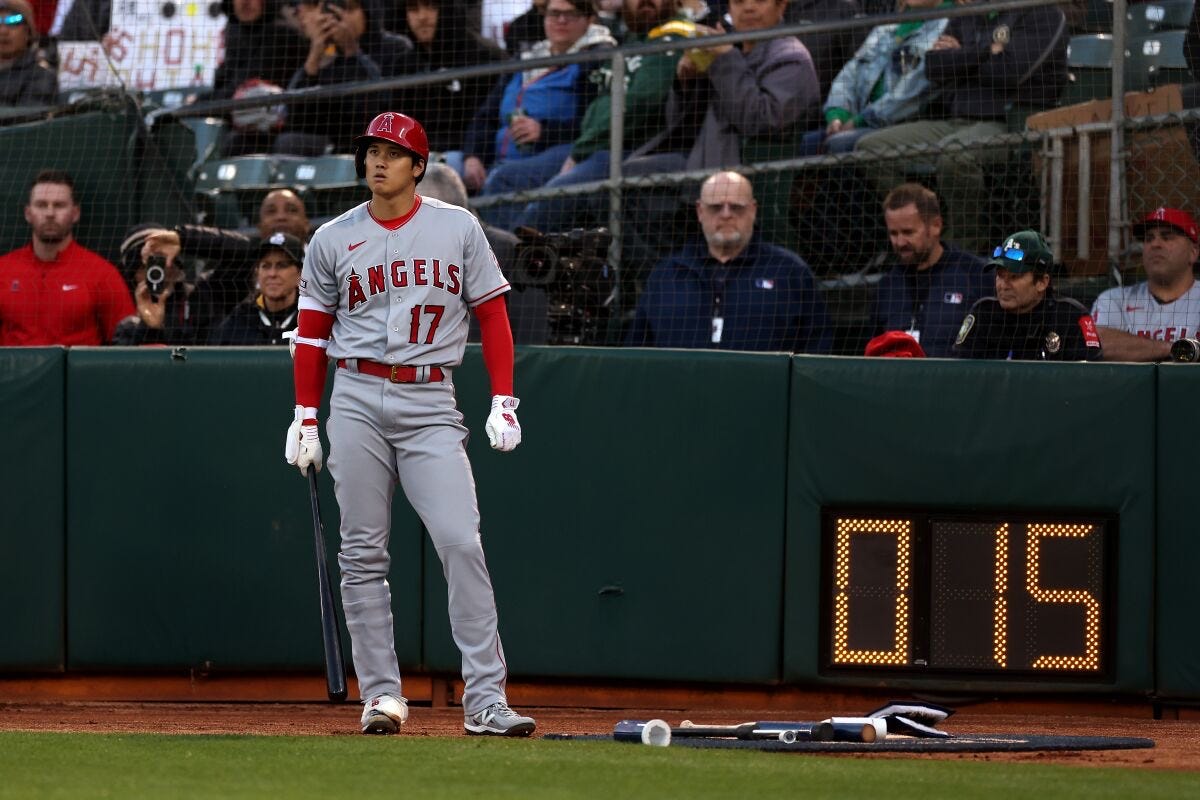
The pitch clock has long been rumored to be on the way in MLB. At first, I was a bit skeptical about baseball having a “shot clock”, but it had worked well in the minor leagues, so it seemed like a natural continuation at the Major League level. The games have become so quick that you almost wonder why the pitchers were given so much time to mess around on the field during games. Was the objective to be “comfortable” on the mound or to simply bore the hitters into submission at the plate? The pitch clock also adds a bit of excitement as crowds have began chanting the time when it drops below ten seconds (think again of a shot clock in basketball). Older pitchers have had a bit of trouble adjusting to the pitch clock, which isn’t a huge shock given that they’ve been playing longer and didn’t experience the pitch clock while playing and developing in the minor leagues. I never thought I’d enjoy a baseball game that took the “freedom” from the players, but it has made for a more fun and interesting experience.

The only downside to this quicker game? Fans who shell out money for tickets and are now getting less game for their money. It almost feels like every change in baseball has been made to improve the television product. When you see the media and television deals that teams are signing, it’s easy to see why it is important to make the game as “viewable” as possible to keep the billions of dollars flowing in. However, more and more teams are doing everything they can to keep fans at the ballpark before, during, and after games. It’s no longer just a “ballpark”, it’s an entire community being built around the stadium. Teams continue to push to move to new ballparks that’ll allow them to own (or at least own a majority share) of everything around the ballpark. Most teams have found themselves either moving, or, exploring ways to move into the suburbs. I can only assume it’s due to the cheaper land and having less political obstacles in the way that may prevent the team from buying and owning all the land around the ballpark.

So, bravo baseball. The games have been fun, fast, and chaotic. Interest seems to be higher and the game is overflowing with young, talented players. It’ll be interesting to see how Major League Baseball continues with this momentum. The next target should be eliminating the archaic blackout policies that lock fans out of watching their local teams via the MLB.tv app. Given the collapse by Bally Sports, that may be happening sooner, rather than later.

Tuesday, February 9, 2021

MLB Deadening Baseballs? But why?

Major League Baseball announced that they are taking steps to "deaden" the baseball in an effort to cut down the record breaking home run rates around the league. While pitchers across the league complained about the ball feeling "different", MLB continued to state that nothing had changed with the ball. 

        AP Photo/Mark J. Terrill 

Before I dig into why I think "deadening" the ball doesn't make much sense, let's take stroll down memory lane. During the 2014 season, many people were complaining about offense being down and hitting being at historical lows around the league. Pitching was dominating and batters seemingly had no answer at the plate. Not only were hitters around the league slumping, but fans were growing more and more frustrated with the product on the field. At the time, analysts blamed strikeout totals (which is interesting due to baseball folks now blaming launch angle and a focus on analytics, but we can save that for another discussion.) A "Grantland" article from 2014 did a bit of a deep dive into the offensive woes of that season  and while I don't want to rehash the entire article, it's interesting to see their arguments and they're mostly the same things people blame nowadays (most notably: shifts and strikeouts). 

Let's face it, modern day baseball has evolved into a data and scientific driven sport. The most efficient way to score is by hitting home runs (and taking walks). Batters can now see their swing and launch data in real-time and have become much better at not only fixing their swings, but also improving their approach at the plate. Just a few seasons ago, fans and analysts were clamoring for more offense, but now that we have a more offensive driven league, they suddenly want to go back to having pitchers dominate? Isn't that counterintuitive? We can say the previous ball was "juiced", but MLB continued to state that wasn't the case. While I personally think the balls were a bit juiced, it doesn't change the fact that the rise in offense was brought about by a change in player training and the new emphasis on embracing technology (Edgertronic cameras literally changed everything about player development.) Training, development, and technology organically drove the offensive advances in the sport. 

It's no shock that MLB feels the need to cut down on the amount of home runs. If you watch a baseball broadcast, you're likely to hear out-of-touch commentators lambasting "launch angle" and "defensive shifts" etc. You may even hear a few commentators pushing for more bunts and wondering why teams aren't playing "A-B-C baseball." 

To me, deadening the baseball is just another attempt by MLB to artificially bring change to the sport. Much like the Wild Card "one-game playoff", which was brought about by the organic energy of Game 162 back in 2011, we are seeing a push towards a man-made change that'll accomplish exactly what the "old-school" folks want to see and not what new age fans want to see. MLB has already eliminated bullpen specialists and imposed a three batter rule for relief pitchers, which I feel takes late game strategy away to improve pace-of-play by a whopping fifty seconds! In addition to that, during the time before folks claimed the ball was "juiced", pitching stats were a bit inflated, but the great hitters still put up their numbers, albeit with a few less home runs. Now, with the offense being boosted a bit, the best pitchers in baseball (DeGrom, Kershaw, Cole, etc.) have all continued to dominate. Which brings me to ask, why do we need to change? If a few scrub hitters slap a few more dingers, is it any different than some scrub pitchers having career seasons due to a dead ball? I'm sure things will once again level out, but do we seriously need to change the ball to cut down on home runs? Who asked for this? 

MLB continues to fall flat in appealing to new, and younger, audiences. Will a change back to more bunts and fewer home runs really bring in new fans? Instead of deadening the ball, why not fix the archaic blackout policies? Why not work on bringing down ticket prices? Why not stop teams from moving from the city to the suburbs (looking at you, Atlanta...)? Why not punish owners who tank the franchise for a tax write off? There's plenty of ways to improve the sport, but "deadening" the baseball will only set the sport back. 

Thursday, June 6, 2019

Where Are They Now? Looking Back at the Braves "Rebuild."

To preface this article, I just want to mention that it would be difficult to mention every player that Atlanta traded during their "rebuild" from 2014-2017. While it would be nice to look back over every transaction, I think it's better to look at the players who actually appeared in the majors during that time. Also, while the "rebuild" started after the 2014 season, the Braves were already moving on from players in previous seasons. So, let's get right to it.

Starting off, let's take a look at the players Atlanta let-go (or traded) who went on to win the World Series. While they weren't all traded, Atlanta wasn't in a position to actually keep some of these players due to having an ownership group that is more focused on turning a profit, rather than actually competing to win championships.

Tim Hudson, Brian McCann, Jason Heyward, Craig Kimbrel, David Ross (twice actually), Evan Gattis, Tommy La Stella, etc. I'm sure there's a few more, but those are the ones that stick out most to me.

In addition to those players, which I will be discussing again shortly, the Braves traded/released/moved quite a few players who find themselves having great success with their current teams.

Most notably, Mike Minor, John Gant, and Tommy La Stella. For a team that preaches the importance of pitching, Atlanta essentially let Mike Minor walk after the 2014 season. He found his way to Kansas City where he established himself as a top left handed reliever during the 2016 season. After signing with the Rangers, he moved back into the starting rotation and currently finds himself amongst the leaders in the American League in most pitching categories.


As for Tommy La Stella, he's finally getting a chance to start for a team and he's having an All-Star caliber season for the Angels. Atlanta never seemed to want to give La Stella a chance to play and he was moved for Arodys Vizcaino, who has since been traded to the Mariners. In 2014, Fredi Gonzalez wanted to play Dan Uggla everyday even though Uggla was a shell of his former self at that point. While La Stella didn't have the fanfare of some of the prospects Atlanta currently has, he always showed the ability to be a contributor at the Major League level.


Moving on, let's take a look at some of the other players Atlanta moved to "rebuild."

La Stella's teammate, Andrelton Simmons was not only a fan favorite, but was a very solid shortstop during his time in Atlanta. He was also only 25 years old and on a team friendly deal at the time of his trade to the Angels. Atlanta received Erick Aybar (who is out of baseball), Chris Ellis (who is now with the Royals), and Sean Newcomb (who looks like nothing more than a back-end starter or middle reliever at this point.) Simmons has gone on to winning more Gold Gloves since leaving Atlanta and has become a much better player offensively than he was during his tenure in Atlanta.


It would be easy to point at the fact Atlanta traded a 26-year old Justin Upton to help them rebuild and get younger, but he has also gone on to put up solid offensive seasons since leaving Atlanta. While Atlanta received a bunch of nothing in that deal, at least they acquired Max Fried, who has been one of the more consistent starters for Atlanta so far in 2019.

Alex Wood is another player I've mentioned numerous times on this blog, so it's kind of like beating a dead horse at this point. However, it was always amazing to me that a rebuilding team would look to trade yet another young cost-controlled left handed starter, but that's exactly what the Braves did in 2014. Atlanta decided to trade the 24-year old in an effort to get "younger and rebuild" and boy did they get quite a haul for Wood. They received Hector Olivera, Zach Bird, and Paco Rodriguez in the trade. Olivera was rightfully released after his numerous domestic violence issues, Bird hasn't pitched since 2016, and Rodriguez hasn't pitched in the majors since 2015. This was another great move made by the club during their rebuilding efforts (if you can't read sarcasm, well that was sarcasm.)

Atlanta was able to "rebuild" their farm system, but it's not as if that was done given the moves by the former GM John Coppolella. Frank Wren was the GM when the club signed Ronald Acuña, Ozzie Albies, Johan Camargo, Julio Teheran, Freddie Freeman, etc. I will be frank (no-pun intended) Wren did a much better job in Atlanta than people give him credit for. While most people in the organization seemed to have hated him, he took a franchise with significant financial restraints and got them back in a position to make the playoffs throughout his entire tenure in Atlanta. John Coppolella had the benefit of always drafting towards the top of the draft and folks in the industry seemed to give him every chance to succeeded while proclaiming all of his moves as "smart" and "great deals" for Atlanta. I don't find that to be accurate at all. Just looking over some of the moves he made during his tenure, you can point to a few that honestly set the franchise back in terms of a "rebuild." That's not evening accounting for the off-the-field issues Coppolella had and his eventual ban from baseball.

Coppolella also seemed to move players just for the sake of moving them. A few players that stick out to me: Ryan Buchter, Chasen Shreve, and John Gant. Gant is especially having a good season with the Cardinals.


Gant could be giving the Braves much needed relief help at the moment, but since Wren left, they've had issues putting together a bullpen. While most fans dislike Wren, you can't argue the fact that he was great at drafting/signing bullpen arms. While Gant was acquired and traded during the tenure of Coppolella, he was never given a chance to actually develop while in Atlanta. They seemed more focused on pitching older vets or players who are out of baseball.


During the "rebuild" in Atlanta, the organization gave up on numerous players who have since found their way to other organizations and are making an impact. Mike Minor is pitching better than ever, Tommy La Stella is playing like an All-Star, and Alex Wood has shown his ability to pitch in the post-season with success.

Craig Kimbrel, who just signed with the Cubs, is still the best closer in baseball and is coming off a World Series winning season with the Red Sox in 2018. Atlanta needed a proven closer, but passed on a chance to sign him to a modest contract in the off-season (and then passed on giving him a contract during the season due to worries over losing a draft pick...) As I've mentioned numerous times, other franchises rebuilt their rosters by trading closers (Andrew Miller, Aroldis Chapman, Brad Hand, etc.) Atlanta sold low on Kimbrel just to get rid of the modest contract given to Melvin Upton.

Speaking of those trades, John Coppolella, for all his accolades, made some of the worst trades in recent memory in all of baseball. If I had to rank them:

1.) The Alex Wood trade to the Dodgers
2.) The Craig Kimbrel trade to the Padres.
3.) The Justin Upton trade to the Padres
4.) The Andrelton Simmons trade to the Angels.

These four trades have netted the Braves a total of: 5.9 wins above replacement (WAR). *Of this total, Sean Newcomb has amounted for 3.9 WAR on his own.*

In that same time, the players Atlanta traded have a total of: 49.4 WAR.

I don't claim to be an expert on analytics, but I think most fans can understand how terrible those trades were for the franchise.


While Atlanta is back to competing for division titles, their biggest issue is still the same: a cheap ownership group that isn't committed to winning. Like I've always said, until that is corrected, this team will always find themselves in a position to be good, but never truly great.

Also, if you've made it this far: hopefully you can sense sarcasm since this article is loaded with it.

Just wanted to credit Baseball-Reference for the stats.


Friday, December 14, 2018

If Not Now, When?

Coming off a 90-win season, many expected the Braves to be aggressive this offseason. However, they've been anything but aggressive. The speculation around this team was that they had "money to spend" and that "no player would be off limits".

Now that we're into December, they've only made one impactful signing, and things are starting to have a familiar feel in Atlanta... Players are too "expensive" to fit in their budget restraints. 


(ALYSSA POINTER / THE ASSOCIATED PRESS)
The local media (and numerous fan blogs) that cover the Braves pushed the narrative that Atlanta could be in the mix for players like Manny Machado or Bryce Harper this off-season. I didn't think that would be plausible given their ownership and their reluctance to spend big on players. As of now, Josh Donaldson ($23M) and Freddie Freeman ($21M) account for the majority of their payroll heading into 2019. This roster has a few modest contracts in Julio Teheran ($11M) and Kevin Gausman ($9M), but the rest of the roster makes little to nothing in comparison.


Fan blogs like TalkingChop, who seem to do more PR work for the team than the official twitter account, spent the entire 2018 season pushing the narrative that the Braves would be in the mix for Harper, Machado, and even Clayton Kershaw (had he opted out). I found an article that stated they would roughly "have up to $72M to spend this off-season." Throughout the season, fans continued to state that Atlanta would sign all these big name players, but again, that does not fit the mold of the Braves' ownership. 

Look back at the 2013 Atlanta Braves (a team that won 96 games and the National League East Title). Going into 2014, they had a modest payroll, but then GM Frank Wren was scrutinized for signing Melvin Upton Jr. (in 2012) to a five year deal worth about $75M. The local media acted as if that deal crippled the franchise and set them back years, when in reality, it was just a modest deal given to a player who was entering his prime. I mention this deal because it was the last high profile free agent contract given out by the team. I don't include Nick Markakis because he wasn't in his prime, nor did he make much on his contract (however, the Braves acted as if they had to penny pinch to get him.) 

Back during that era, the Frank Wren era, the Braves never spent on free agents. Most of the big name players were acquired in trades or prospects that graduated to the Major League roster. The biggest signings the Braves made in recent history were Ervin Santana (1-year $14M), Nick Markakis (4-years $44M), Melvin Upton Jr. (5-year $75M), and that's about it. The Ervin Santana deal had to be specially approved because of the Braves budget restraints. That's right the GM of a 96-win team essentially had to beg to sign a pitcher after the rotation suffered numerous injuries in Spring Training of 2014. The 2013 Braves were in a similar situation as this current Braves team and they choose to not improve the team and then, they blew up the roster right as the players on that roster were about to enter free agency. They kept Freeman and Teheran, but the rest of the roster moved onto other teams via trades or they were essentially let go. (It's worth noting that Heyward, McCann, Kimbrel, Medlen, Hudson, etc. all won the World Series on their new teams following their exits from Atlanta and numerous others like Alex Wood and Luis Avilan have appeared in the World Series, albeit, not winning.) You could argue that the 2009-14 teams were even more talented than the 2018 Braves roster, but their refusal to spend and improve the roster kept them from seriously contending for a title.  

For years, the Braves have operated like a small-to-mid market team. Part of the reason why they wanted to move into a new stadium was so they could "spend more" with the increased revenue generated by the new ballpark. There's other factors that played into this, but essentially, the promise was that a new stadium would generate so much added revenue that the franchise wouldn't have to be as conservative during free agency. However, this doesn't seem like the truth. 

In terms of media markets, Atlanta is currently the ninth largest media market in America (via City-Data.com). They're between Houston and Boston in terms of market size, yet, those are two teams who are willing to spend at will to improve their rosters. Atlanta's payroll in 2018 was 18th in Major League Baseball (according to Spotrac). The Braves' modest television deal was supposed to be alleviated by the move to the new ballpark in Cobb County, but that apparently isn't the case. They're still spending like a small-to-mid market team.

This brings me to my original question: If not now, when? 
The Braves rebuild was essentially completed last season. They won the division and have the talent in place to be a very good team in 2019. Division rivals like the Mets, Nationals, and Phillies have already spent big this off-season and look to continue spending to field competitive teams in 2019. Yes, the Nationals aren't bringing back Bryce Harper, but they did sign the top free agent pitcher Patrick Corbin. The Phillies have already added Jean Segura and look poised to sign one of (or perhaps both of) Manny Machado and Bryce Harper. The Mets have added to their bullpen (Familia) and traded for Robinson Cano and Edwin Diaz. Yes, even the Mets are being aggressive this off-season. I attribute the aggressive nature of the division squarely on the fact that the National League East just wasn't that good last season. The other teams feel as if they're not too far off from Atlanta and with the Braves mostly standing pat, they're being aggressive and positioning themselves to have a shot to take the division title in 2019. 

If now isn't the time to spend, when will that time come?


The Braves have real holes on the roster and they cannot continue to patch them with past prime veterans like Nick Markakis or even Josh Donaldson. Donaldson may have a fine season, but he's also turning 33-years old in 2019 and only signed to a one-year deal. The franchise is either banking on Austin Riley being the real deal or they think Johan Camargo can be an everyday third baseman in the future. I think Camargo is best in the middle infield given his offensive production. When you have a young team in place, you're not trying to build an entire roster full of free agents (think of the Marlins when they moved into their new ballpark a few years back.) 


Let me ask other fans this... Do you seriously think this team can compete for a World Series Title?


This team was greatly exposed by the Dodgers in the post-season and they need hitters who can actually hit the ball out of the park. This team is built for stringing together singles and not striking out (you need walks and home runs, something the 2013 team excelled at doing) and that style just doesn't work in the playoffs. Acuña and Freeman are the only power threats in the line-up and they're still without a starting quality right fielder. Free agents like Michael Brantley seem to be too expensive for the Braves and they're not in the mix for Harper either. So, where do they go from here? It appears that they're looking to trade for an impact hitter, but why give up prospects when there's adequate players available in the free agent market? The farm system may be full of pitching, but they still lag behind other rebuilds due to the lack of impact hitters. Yes, Acuña looks to be a great player for the foreseeable future, but there's not much besides him to look forward to. Ozzie Albies has promise, but he's still inconsistent at the plate and doesn't look like he can be counted on for offensive production (no walks and streaky power). This team also needs a few pieces in the bullpen, but I'm sure they'll look at internal options to fill that void (however, that won't solve the bullpen management issues exhibited by manager, Brian Snitker.) Cristian Pache, Austin Riley, and William Contreras look to be the next hitters to come up in the system, but Riley has contact issues while Pache and Contreras are both 19 and 20 years old respectively. These players also look like potential trade pieces, but I doubt they're moved unless they can bring back an All-Star caliber player. 

Once again, this team has a young roster in place with no real salary obligations and they're still not spending. This is the best free agent class in recent memory and they're still not in the mix for a big name player. 

So, with a division winning team full of young players who may take the next step... why wouldn't you try to add at least ONE big name free agent to mix and take the next step? If they don't try to improve the roster to take the next step, this team MAY be dismantled in a few years and thus, in a state of a constant rebuild. Once the young players on the roster are deemed "too expensive" they'll be shipped off and suddenly, the local media will push narratives about how "they weren't that good anyway" and how "this team wasn't winning the World Series anyway!" I say this because that's basically what happened to the 2013 team. I've been critical of the front office in the past, but it's clear that cheap ownership is the real reason why this team is constantly held back from taking the next step.

If now isn't the time for Atlanta to spend on a big name free agent, when will it be?

*UPDATE*

Noted Braves' target Michael Brantley, according to multiple reports, has signed a free agent deal with the Houston Astros. While all the details haven't been released, it's looking like a 2-year/$32M deal. A player of his caliber signing a deal at that price looks like a perfect fit for what Atlanta was looking for. Sure, he may have preferred the Astros and the chance to DH and possibly play 1B, but multiple reports by Atlanta media outlets claimed that Brantley would be "too expensive for the Braves" and that he would be looking for a massive "five year deal worth around $100M."

Again, was he too expensive? Did the Braves try to offer him a deal? Seems odd to let a hitter who would be the perfect fit in Atlanta go for well below his market value (and on such a team friendly deal.)

If Atlanta had worries about his injury history, I cannot see them pursuing A.J. Pollack, when he has even worse injury history than Brantley (and will probably cost much more in terms of years and money.)


Wednesday, June 27, 2018

Is The Braves' Bullpen Really This Bad? - Does Alex Anthopoulos Need to Make a Move?

The Braves currently find themselves leading the National League East. However, as the season grows it's becoming more apparent that the Braves have some major issues in their bullpen. The bullpen has been hit or miss and lately, it's been more miss. While it's easy for most fans to point to the duo of Peter Moylan and Sam Freeman as two of the biggest problems, I think the bullpen issues go beyond two guys who have struggled. Brian Snitker's bullpen management has been questionable ever since he took over for Fredi Gonzalez. To me, his biggest issue is his hesitance to use his best relievers in high leverage situations early in games. Snitker has a tendency to pull his starters around the fifth and sixth innings, which is understandable given the youth in the rotation, however he tends to let his worst relievers pitch critical innings in the middle of games.

(Kevin Cox - Getty Images) 

Take a look at the game today against the Cincinnati Reds. The Braves pulled starter Sean Newcomb and replaced him with Sam Freeman. Freeman took over in the 7th inning and proceeded to give up three earned runs in 2/3 of an inning. Freeman, at best, is a lefty specialist, yet Snitker continues to let him be exposed against right handed batters. For reference, Freeman has a .178/.315/.364 slash against him when facing lefties. His biggest issue is his command as he walks way too many batters to be an elite reliever in the bullpen. To make matters worse, Snitker still brought in A.J. Minter and Dan Winkler to pitch after the lead had been given up by Freeman. Again, why not use your higher leverage relievers before you bring in the preverbal white flag guys (Freeman and Moylan)? If you're going to use them when there's no lead to protect, they're being wasted.


Snitker seems so set on going by the book that he doesn't realize that sometimes, the most important inning of the game occurs before the ninth inning. While other teams are allowing bullpen guys to act as an "opener", the Braves continue to pull their starter early and follow them up with the worst options in the pen. I know that this is an approach that many don't agree with, but when your starters are only going five or six innings, wouldn't it be interesting to start the game with someone like Minter or Carle and then bring in your starter to pitch the middle of the game? After that, you can hand it over to your other top two or three options and the game would go the same way. Instead of pulling your starter in the fifth or sixth inning, you're able to let them pitch deeper into the game and it solves the issue of having to use your worst options early on in the game. I don't see the Braves doing anything like this and I don't think Snitker or the Atlanta media would allow such a drastic change that goes against the "traditional book" of baseball. When the Braves played Tampa Bay and San Diego earlier this season, Chip Caray and Joe Simpson both made their share of jokes at the idea of an "opener." Needless to say, the Braves don't seem to be the most progressive team, even after hiring Alex Anthopoulos.

With that said, do the Braves need to make upgrades to the bullpen? I think that depends on whether or not Anthopoulos believes his team can truly compete for a playoff spot in 2018. This team is contending much earlier than anyone could have expected, but do they trade their minor league depth for a late inning reliever? To be honest, I think they need to stand pat with what they have and only make a minor move to try to solve some of the bullpen issues. I don't think it's worth trading away depth to make a failed playoff run in 2018. I'd save those prospects for bigger moves in the off-season. The cost for high end relievers has skyrocketed over the past few years and I just do not think it's worth it to go after someone like Brad Hand or Raisel Iglesias. While they're both great relievers, I think there's still a lot of issues with this team. Third base is still a huge question mark and Dansby Swanson still isn't living up to the hype or expectations placed upon at shortstop him by the media. Basically, the issues with this team go beyond the bullpen. Snitker, shortstop, third base, and the bullpen are all massive question marks. Fixing one with a high cost relief pitcher (high cost = top prospects) does little to solve the pressing issues with this team. It's just putting a bandaid on one issue and leaving the others to be exposed.

I think the biggest move Atlanta could make is to fire Brian Snitker. While some fans seem to think he's a great manager, there's a growing divide amongst fans who think he cannot manage the bullpen effectively. As you can tell, I clearly think he does a poor job of managing the bullpen. This bullpen may not be "elite", but there's enough pieces there to win many games. However, Snitker continues to mismanage the pen, which causes games to go 15 innings and causes the bullpen to be overworked and not effective as time goes on. Anthopoulos needs to bring in a fresh face to complete the rebuild in Atlanta. Brian Snitker still represents the old ways in Atlanta and to be honest, it feels like he brings complacency. In a perfect world, Atlanta would go after someone with no previous ties to the last coaching staff. It's time to look past the Bobby Cox disciples like Fredi Gonzalez and Brian Snitker, as they all seem to make the same mistakes with bullpen management and in-game tactics. Brian Snitker is the type of manager to pinch-hit for a pitcher with a position player, just to have him bunt. Yeah, that's not how you win games in 2018........

Anthopoulos has some big question marks that he needs to correct at some point. I think Snitker will finish up the season managing the Braves and they'll remove him in the off-season. The Braves are now a very attractive option for all mangers and it's clear they're no longer set on "tanking" to rebuild. Much like the Astros years ago, it's time to let the old-school manager go and bring in someone who's open to trying new approaches. The Astros found their manager in A.J. Hinch (after firing old-school baseball guy Bo Porter, who ironically works with the Braves now), the Braves need to figure out who can take their roster to the next step. I can't speak on who they should go after, but with Dave Martinez and Gabe Kapler managing division rivals, the Braves will have to make sure they find someone who can match up with them tactically, or else they risk their "rebuild" never getting over the hump. This off-season will be huge for the Braves franchise and it'll be interesting to see what Anthopoulos decides to do. A lot could be solved with getting a new manager and signing a free agent bat or two. Manny Machado would be a great upgrade at shortstop and they should still have plenty of money left to make another splash or two. Until then, we'll just have to see how the 2018 season unfolds. 


Friday, July 7, 2017

Looking Back At The Shelby Miller Trade.

(Christian Petersen/Getty Images North America)


When the Braves dealt Shelby Miller to the Diamondbacks, social media exploded with the consensus being that the Braves "won" the trade. However, it might not be as much of a "win" as people claimed it to be.

I won't deny the fact that I was one of the people who claimed this trade to be a huge win for the Braves. After dealing Andrelton Simmons, the Braves still had Ozzie Albies waiting in the wings to play shortstop, but acquiring a prospect like Dansby Swanson helped to ease the loss of Simmons. Swanson came up during the 2016 season and looked to be an immediate superstar for the Braves. Hell, he was featured in commercials for the Braves before he even made his Major League debut. The Braves have marketed him as a superstar, so fans immediately placed unrealistic expectations upon him. He lived up to the hype, slashing .302/.361/.442 in his first 38 games. Many experts labeled him as the sure bet to win Rookie of the Year for the 2017 season, however, he hasn't been able to sustain his amazing start to his career. So far in 2017, he's only slashing .227/.301/.333. Unlike some others, I did expect Swanson to experience a bit of trouble in his first full season in the majors, but his extended poor play leaves him looking less like a "future hall of famer" as some fans called him (I am being for real when I say that) and more like a replacement level shortstop.

With all that said, I'm not ready to give up on the kid just yet. I think he's too talented to toss aside because of a rough first full season in the majors. I think he's talented and deserves his fair shot to prove he can make it at this level. It's just worth pointing out that you can't base a player's career off 38 games in the majors. I'd even say that judging him off of this season is harsh, but his sample size grows by the day and outside of a nice month of June (.306/.355/.418) this season hasn't lived up to the immense hype put on him by the fans of the Braves.

Getting back on track, it's time to look back at the trade that sent Shelby Miller to the Arizona Diamonbacks. On paper, the Braves did quite well in this trade. It's hard to argue against acquiring your everyday shortstop and an All-Star outfielder, Ender Inciarte. The third piece of the trade for Atlanta was pitching prospect Aaron Blair. Considered as a "throw in" in this deal, many considered him to be the steal of the trade. However, he's been a disappoint in his time with the Braves organization. In 15 starts with the Braves last season, Blair went 2-7 with an ERA well over well over 7. Win/loss record and ERA aren't the most important stats in the world, but even his strikeouts per nine (5.9) and his walks per nine (4.4) just aren't enough to be effective at the major league level. Not to mention the fact he gave up over 10 hits per nine innings as well. The Braves have kept Blair in the minors so far in 2017 and his numbers aren't improving. So far, he's 6-4 with an ERA over five. For old school fans who like wins, I'd guess they'd be happy with his win/loss record, but just glancing at his stats you can see he has still been largely ineffective.

The brightest spot of this trade for Atlanta has been Ender Inciarte. Inciarte was just named an All-Star, so congrats to him on that feat. He's been the best center fielder the Braves have had since Andruw Jones left to join the Dodgers years ago. His attitude and work ethic are what fans love to see and you could argue that he's the most important position player on the roster. He plays Gold Glove caliber defense and his offense has been essential for the Braves. As I mentioned, I think he is the most valuable player on this team. As the old saying goes, as he goes, the Braves go. Freddie Freeman is the best hitter on the team, but his lack of defense and base running greatly diminishes his overall value. We're talking about all around value here, not just what you can do with the bat. This is bringing back memories of the Trout vs Cabrera case just a few years back. Ender Inciarte is the most exciting player on the Braves and I feel comfortable saying that. Again, that's not to take anything away from Freddie Freeman, but there's only so much a first baseman can do to make things exciting. However, with Freeman playing third base occasionally now, we might get to see some fun "effort" being shown at the hot corner.

Now, was this trade bad for the Diamondbacks? Well, it's a mixed bag. You could argue that dealing Inciarte hurt their lineup, but they have A.J. Pollack and David Peralta on the roster. David Peralta is almost the exact same player as Ender Inciarte. They both put up modest, to above average production at the plate and both play above average defense. In fact, using a blind eye test:

Player A: .311/.360/.473

Player B: .306/.351/.412

Player "A" is David Peralta and player "B" is Ender Inciarte. As I was saying, there's not much difference between the two offensively. So, losing Inciarte didn't really hurt the Diamondbacks as much as you'd want to think. In fact, Peralta has been just a bit better offensively than Inciarte has been this season. Last season, Arizona had Jean Segura at shortstop and he did an amazing job for them. He was later dealt to Seattle for Taijuan Walker, but they did not initially miss Swanson at shortstop. They have used a combination of Chris Owings and Nick Ahmed at shortstop this season and both players have done a great job. Ahmed isn't much of a hitter, but plays above average defense (0.4 dWAR in 53 games) and Owings has been very effective at the plate hitting .283/.323/.490 on the season. While neither player may have the potential upside of Dansby Swanson, they're both doing a capable job playing shortstop.

The final part of this trade is Shelby Miller. It's difficult to quantify him due to his ineffectiveness last season and his short run this season due to injury, but he was pitching more in line to his career numbers this season, so there is hope for the Diamondbacks that he will at least be a decent contributor for them when he is able to pitch again. The Diamondbacks have found success using both Zack Godley (2.8 WAR) and Randall Delgado (0.9 WAR) to make up for the loss of Miller. It's worth noting that Godley was acquired from the Cubs for Miguel Montero, who they recently released. As you can imagine, they would like to have Godley right now given the performance by their rotation so far in 2017. Much like the case for Swanson, we all are just going to have to wait and see what exactly Miller can bring the Diamondbacks. He has the potential to at least be an average major league starter, but again, time will tell with him.

So, looking back at this trade, it's hard to pick a definite "winner" or "loser" at this point. You can say the Braves won the deal just for the sake of getting Swanson and Inciarte, however, Swanson has yet to live up to hype placed upon him by fans in Atlanta. I do think he'll be a fine shortstop moving forward, but he may not be the "future hall of famer" some fans were portraying him as being. As long as he's a league average shortstop, I think Atlanta fans should be happy. Also, it's hard to say that the Diamondbacks really miss Inciarte or Swanson due to them replacing them with Peralta and Owings. Granted, nobody anticipated Owings playing this well in 2017, but he has shown flashes of being a solid player the past few years.

So, who wins and loses this one? Well, that's for you to determine. I have a feeling Atlanta fans will claim they won and Diamondback fans will say it wasn't as bad as first thought. Maybe people can actually let trades play themselves out before claiming a team "won" or "lost?" Then again, staying rational doesn't get clicks... So, I'm guessing that won't be the case moving forward. Oh well.

Thursday, June 8, 2017

Re-Evaluating The Alex Wood Trade

While many fans seem to applaud most every move made by current Braves' GM John Coppolella, he has made his fair share of questionable moves. Perhaps his most questionable trade: trading Alex Wood to the Dodgers. In this trade, Atlanta received: Paco Rodriguez, Hector Olivera, and Zachary Bird.

( Source: Jayne Kamin-Oncea/Getty Images North America) 


As someone who follows the Braves closely, most fans were surprised by the move, but seemed
alright with trading Alex Wood because, "he's going to be injured soon anyway." From the start, fans seemed to not have much faith in Wood due to his mechanics. And while worrying is understandable, the fact remained that Wood was an above average starter during his time in Atlanta. Combined with his age and modest contract, Alex Wood was essentially a steal in the second round by former Braves' general manager Frank Wren.

Alex Wood seemed like the kind of piece a team would want to build around. Especially a rebuilding team like the Braves. However, Coppolella had an unbridled desire to land Hector Olivera. It was rumored that the Braves had made a very serious offer to Olivera before he signed with the Dodgers. Determined to get his man, Coppolella dealt Alex Wood to the Dodgers. Also included in the deal was then top prospect José Peraza, another piece Atlanta could have used to build around. While Peraza might be a bit limited offensively, he makes good use of his tools: ranking third in triples, fourth in stolen bases, third in defensive assists, third in double plays turned as a second baseman, and third in total zone run as a second baseman. He may not be an All-Star, but he is a very serviceable player at the Major League level. Luis Avilan was also dealt to the Dodgers and he has also been very serviceable. It's worth noting that the Braves don't have a lefty reliever with an ERA under 5.48 (Sam Freeman has been solid, but with half the sample size of EOF and Ian Krol.) Peraza and Avilan were basically "throw-ins" in the trade for Olivera and would both be valuable pieces to the current Braves' roster.

Looking back at the pieces the Braves received for Alex Wood, well, there's nothing much to see at all. None of the players sent to Atlanta are still in the organization. Hector Olivera was released following his very serious domestic violence incident, Zachary Bird is now in the Rangers organization, and Paco Rodriguez is seemingly out of baseball rehabbing injuries (was released by Atlanta at the end of spring training.)

While Alex Wood continues to thrive in Los Angeles, I see a lot of Braves fans on Twitter still stating that, "he's going to get hurt with his mechanics!" It's almost as if they want him to be injured so they can claim Atlanta, "won the trade!" Given the pieces Atlanta received for Alex Wood, just him being on a Major League roster is a win for the Dodgers.

Some fans point that this trade eventually led to Atlanta getting Matt Kemp, and that alone is enough to make most of them happy. However, Matt Kemp hasn't been very valuable in his time with Atlanta. If you look at his offensive stats, you'll see he's been above average, but he looks much more suited as a DH in the American League than someone you'd want to plug in the outfield everyday. While he's hitting a robust: .322/.357/.553 this season, his defense is atrocious. Even with posting an OPS of .910, he's barely above replacement level due to his defense. He's on track to finish the season with around a 2-3 WAR (bb-ref). While some point to his arrival last season and the Braves solid finish to the season, there's now been a bigger sample and it's clear that he's not having that much of an impact on this team in 2017. If you play a replacement level player everyday and give them enough at-bats, they're going to have solid stats. Ender Inciarte and Freddie Freeman both bat ahead of him and they're very good at getting on base. Kemp can compile offensive stats when he's constantly coming up with people on base. It's just like, say, Brandon Phillips batting behind Joey Votto while in Cincinnati. Phillips and Kemp both lack plate discipline to take walks, but they usually put the ball in play and drive in runs at decent rate. I think the law of averages will tell you that if you come up enough with guys on base, you're bound to drive one in every once and a while. To be great at it in baseball, you simply need to be successful, what... 27% of the time? Besides, RBI's are overrated in my opinion. Congrats, your teammates did all the work and you got a hit! Buster Posey is on pace to have over 20 home runs and something like... 50 RBI's. I'd argue that having him hit where Kemp is on he Braves, he'd have well over 50 RBI's at this point. Even Nick Markakis has over 30 RBI's and he just slaps singles all over the ballpark.

Getting back on track, Atlanta essentially traded young building blocks to just to end up with an aging Matt Kemp. As it stands, the Braves offense is actually pretty solid. They rank in the top ten in the National League for team OPS, and they are in the top three in both team average and on-base. Offense isn't the biggest issue with this team, but their rotation is a nightmare. Adding two 40+ year old starters to the mix wasn't the answer, and thus, even more reason why the Alex Wood trade was a colossal failure. Even if Alex Wood kept on his pace he had in Atlanta, he'd be the ace of their rotation. For a team that continuously talks about wanting pitching, continuously drafts pitching, and still has pitching issues, dealing a young (and cheap) starter never made much sense. Maybe the Braves only saw Wood as being a back end guy or a reliever? Guess we'll never know.

As the Braves continue their long rebuild, the "new car smell" with Coppolella might be wearing off for some fans. While there's an abundance of pitching prospects, most of the notable hitting prospects in the system are carry overs from the Frank Wren era: Ozzie Albies, Ronald Acuna, Braxton Davidson, Randy Ventura, Carlos Castro, Joey Meneses, and Luis Valenzuela. Although, I'd argue that the most exciting minor league hitting prospect (not named Ronald Acuna) might end up being Alex Jackson, but he seems to be dealing with injuries this season. Jackson also seemed to have issues with Mariners' organization, so there's no telling what to expect out of him moving forward. While the Braves continue to have draft picks inside the top five, they're bound to produce one or two major hitting prospects as time goes on. Having draft picks that high is also something that the previous front office didn't have the luxury of experiencing, but they still produced many players on current Major League rosters.

The draft is fast approaching and it'll be interesting to see which route the Braves take this year. Will the finally draft a high upside college bat? Or continue to build around high school pitching? When you look around the league, taking upside college bats seems to be the way to rebuild, but I guess that's not "the Braves way!" 

So, while the Braves continue to search for pitching, Alex Wood continues to shine for the Dodgers. The Braves are left with an expensive, aging, one dimensional outfielder in Matt Kemp. Hector Olivera is playing Indy league ball with seemingly no future in Major League Baseball. No matter which way you cut it, this may go down as the worst trade in the John Coppolella era in Atlanta. 

Friday, July 1, 2016

The Side Effects of Bunting


            The Braves, Phillies, Brewers, Rockies, and Reds are near the bottom of the standings in the National League, but they are all in the top five in one category… Sacrifice bunts.
             Back in the day, bunts seemed to be an essential part of the game of baseball. Get a runner on, get him over, and get him in. That’s “ABC baseball” and it’s something teams swore by until the recent sabermetric revolution many teams began following.
            Pitchers bunting is one thing, but far too often it seems like teams are having more and more batters sacrifice their at-bat in an effort to squeeze one run out of an inning. Regardless if the opposing pitcher has walked two batters and looked totally off, teams continue to bail them out by giving away outs. It’s almost as if teams are settling for one run when they could potentially score two or three runs easily, if they wouldn’t give away an important out.
            Over the weekend, I watched the Braves and Mets play… I found myself becoming more and more angered at the decision-making put in place by the Braves decision making. During the game Friday night, Tyler Flowers led off the ninth inning with a single and Erick Aybar was hit by a pitch… Thus, giving Atlanta two base runners with no outs. With the winning run at the plate and no outs, Brian Snitker called on Chase d'Arnaud to pinch hit. He immediately hit into a double play while trying to advance the runners with a bunt. Nobody seems to want to ask why he’d call upon his pinch hitter to bunt (if you’re going to do that, why not just use a starting pitcher instead of wasting a bench bat?). But this move was a classic Barves moment and yet another game lost by Atlanta via poor managing. 
Freddie Freeman bunting... Because why not? (AP Photo/John Raoux)
            After all of that, the Braves found themselves in a similar situation during the game Saturday night. Jace Peterson led off the inning with a single and Ender Inciarte followed with a sacrifice bunt. Traditional fans may see this as playing for a run, but this essentially gave the Mets a free out and opened up first base. Which, the Mets immediately intentionally walked Freddie Freeman to set up a double play. Nick Markakis hit directly into the defense and the Mets turned a game ending double play.
            This is just a small snippet of a disastrous season that the Braves are going through. It’s also just another reminder of how important it is to have a manager and front office that embraces a more analytical approach. It’s easy to second-guess managers when things do not work out, but there’s an abundance of data available to illustrate how bunting only decreases a team’s chances of scoring a run.
            The most surprising stat to me is that the Angels have 23 sacrifice bunts. That’s right, an American League team has had 23 sacrifice bunts…. That’s five more sacrifice bunts than the closest American League team (Royals) and the Angels have more bunts than eight National League teams. The Angels have played 15 interleague games, but looking over their team stats, I found that they’ve had no sacrifice bunts by pitchers. This is a lineup that features five batters with an OPS+ over 100 and arguably the best player in Major League Baseball, Mike Trout. If you do a quick Google search for “Mike Scioscia bunting” you’ll be rewarded with numerous articles expressing their anger towards his calls for sacrifice bunts. What’s even more appalling to me is how the Rockies can have the second most bunts in baseball (32) and the majority of those bunts are by DJ LeMahieu, who has a .326/.394/.496 slash line… And he’s the guy dropping down sacrifice bunts and giving himself up for lesser hitters to drive runners in.
            The Braves, Reds, Phillies, Brewers, Rockies, and Angels are a combined 195-264 this season. Personally, I don’t think it’s much a coincidence that the worst teams in baseball are some of the most frequent bunters in the game. The majority of these teams employ “old-school” managers who seem more worried about managing to not lose rather than managing to win.
            The bunt will never truly go away. As long as the National League continues to go without the DH, we will always see pitchers batting and trying to lay down sacrifice bunts. That might also be changing given the offensive explosion by National League pitchers at the plate this season. In Madison Bumgarner’s last start, San Francisco elected to forgo having a DH in the line-up and allowed Bumgarner to bat for himself. The result? Bumgarner went 1-for-4 at the plate with one run and a strikeout. His hit, however, was a line drive to center field that had 103-mph exit velocity, according to MLB StatCast. Will more teams follow suit and allow their star pitchers, who can swing the bat, a chance to bat for themselves? Or will they always be reduced to dropping down bunts because that’s what “the book says to do!!”  By the way, where can one purchase the book that old-school managers go by? Is it located next to the aisle where they sell hats to tip? Hmm… In the end, I guess it is easier for managers to justify a batter bunting instead of swinging away in a run-scoring situation. However, baseball is an ever-changing sport. Some teams have adapted, but others are being left in the dust. Some teams are complaining about shifts, bullpen micro-managing, and pitching limits on young pitchers, but they seem to have no problem with putting themselves at a run scoring disadvantage by bunting. Here’s a great clip from the movie “Moneyball” that sums up things nicely.